

Introduction to Mamaearth Case Study 2026
India’s beauty and personal care industry has experienced remarkable growth over the past decade. Consumers are increasingly choosing products that are natural, toxin-free, sustainable, and environmentally friendly. Among the brands that successfully capitalized on this trend, Mamaearth stands out as one of the most prominent success stories. This Mamaearth case study explores how the company transformed from a startup into one of India’s leading direct-to-consumer brands through a strong Mamaearth business model, an innovative Mamaearth revenue model, and a highly effective Mamaearth marketing strategy.
Founded in 2016, Mamaearth entered a highly competitive market dominated by multinational corporations and established domestic brands. Despite these challenges, the company rapidly gained customer trust through transparent communication, natural ingredients, and digital-first growth strategies.

This Mamaearth case study examines the factors that contributed to its rise, including product innovation, digital marketing excellence, omnichannel distribution, and customer-centric operations. By understanding the Mamaearth business model, businesses can gain insights into building scalable consumer brands in the digital age. Similarly, analyzing the Mamaearth revenue model and Mamaearth marketing strategy provides valuable lessons for startups and entrepreneurs.
Company Overview
This Mamaearth case study begins with an overview of the company.
Mamaearth is an Indian personal care and wellness brand that focuses on toxin-free and natural products. The company offers products across multiple categories, including:
- Skincare
- Haircare
- Baby care
- Body care
- Face care
- Wellness products
The company built its reputation by addressing consumer concerns regarding harmful chemicals in beauty and personal care products.
The growth story discussed in this Mamaearth case study demonstrates how understanding consumer needs can create massive business opportunities.
History and Growth Journey

A significant part of this Mamaearth case study involves understanding its growth journey.
The founders launched Mamaearth after experiencing challenges in finding safe products for their child. This personal experience inspired them to create a brand focused on safe, toxin-free products.
Important milestones include:
- Launch of baby care products
- Expansion into skincare
- Haircare product launches
- Digital-first expansion
- Omnichannel retail growth
- Public market listing journey
These developments became key pillars of the Mamaearth business model and helped the company establish a strong market presence.
Mamaearth Business Model Explained
The Mamaearth business model is based on direct-to-consumer sales, product innovation, sustainability, and digital engagement.
One of the most important strengths of the Mamaearth business model is its ability to quickly identify consumer trends and launch relevant products.
Direct-to-Consumer Approach
The foundation of the Mamaearth business model is the direct-to-consumer approach.
Customers can purchase products directly from:
- Official website
- Mobile platforms
- Online marketplaces
This approach allows the Mamaearth business model to maintain stronger customer relationships and higher margins.
Product Diversification
Product diversification plays a critical role in the Mamaearth business model.
The company continuously expands its product portfolio across multiple categories.
Benefits include:
- Reduced business risk
- Increased customer lifetime value
- Cross-selling opportunities
Diversification significantly strengthens the Mamaearth business model.
Digital-First Operations
A major feature of the Mamaearth business model is its digital-first approach.
The company uses data and analytics to:
- Understand customer behavior
- Launch products faster
- Optimize marketing campaigns
- Improve customer experience
Technology integration enhances the efficiency of the Mamaearth business model.
Omnichannel Distribution
The Mamaearth business model combines online and offline channels.
Products are available through:
- E-commerce platforms
- Brand website
- Retail stores
- Modern trade outlets
This omnichannel strategy increases the reach of the Mamaearth business model.
Sustainability Focus
Sustainability is a core element of the Mamaearth business model.
The company promotes:
- Environment-friendly packaging
- Tree plantation initiatives
- Natural ingredients
- Sustainable operations
These efforts improve customer trust and support long-term growth within the Mamaearth business model.
Community Building
Community engagement is another important pillar of the Mamaearth business model.
The company actively interacts with customers through digital platforms and social media channels.
This strengthens customer loyalty and improves the effectiveness of the Mamaearth business model.
Brand Portfolio Expansion
The Mamaearth business model has evolved beyond a single-brand strategy.
The company has expanded its portfolio to serve multiple consumer segments, creating new opportunities for growth and diversification.
Mamaearth Revenue Model Analysis
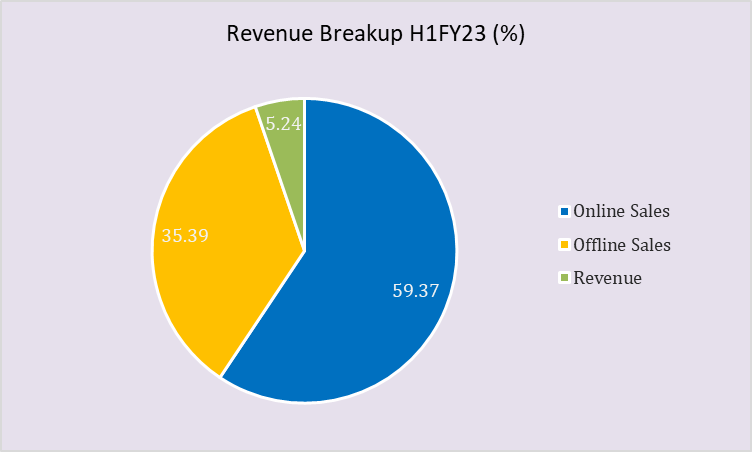
Understanding the Mamaearth revenue model is essential for evaluating the company’s financial performance.
The Mamaearth revenue model consists of several revenue streams that support scalable growth.
Product Sales Revenue
The largest component of the Mamaearth revenue model comes from product sales.
Revenue is generated through:
- Skincare products
- Haircare products
- Baby care products
- Wellness products
Product sales remain the foundation of the Mamaearth revenue model.
Direct Website Revenue
Direct website sales contribute significantly to the Mamaearth revenue model.
Benefits include:
- Higher margins
- Better customer insights
- Increased brand control
This channel strengthens the profitability of the Mamaearth revenue model.
Marketplace Revenue
Online marketplaces contribute substantially to the Mamaearth revenue model.
These platforms help the company access a larger customer base and increase sales volume.
Marketplace distribution remains a major driver of the Mamaearth revenue model.
Offline Retail Revenue
Offline retail expansion has become increasingly important within the Mamaearth revenue model.
Retail presence improves:
- Brand visibility
- Product accessibility
- Customer trust
This channel further diversifies the Mamaearth revenue model.
Repeat Purchase Revenue
Customer retention plays a significant role in the Mamaearth revenue model.
Repeat customers contribute recurring revenue through regular purchases.
Strong customer loyalty enhances the sustainability of the Mamaearth revenue model.
New Product Launch Revenue
Innovation drives additional growth within the Mamaearth revenue model.
New product launches create opportunities to attract customers and expand market share.
This innovation-focused approach supports the scalability of the Mamaearth revenue model.
International Revenue Opportunities
Global expansion presents future opportunities for the Mamaearth revenue model.
International markets offer access to new consumer segments and growth potential.
Future Growth Drivers
Several trends are expected to strengthen the Mamaearth revenue model:
- Premium product categories
- International expansion
- Omnichannel growth
- Digital commerce
- Brand portfolio diversification
These opportunities will likely shape the future evolution of the Mamaearth revenue model.
Mamaearth Marketing Strategy Analysis
The success highlighted in this Mamaearth case study is closely linked to the company’s innovative Mamaearth marketing strategy.
The Mamaearth marketing strategy focuses on digital marketing, influencer partnerships, customer trust, and purpose-driven branding.
Influencer Marketing
One of the most important pillars of the Mamaearth marketing strategy is influencer marketing.
The company collaborates with:
- Beauty influencers
- Parenting influencers
- Lifestyle creators
- Social media personalities
These partnerships significantly strengthen the Mamaearth marketing strategy.
Content Marketing
The Mamaearth marketing strategy relies heavily on educational content.
Content focuses on:
- Product benefits
- Ingredient awareness
- Beauty tips
- Parenting guidance
This educational approach improves customer trust and supports the Mamaearth marketing strategy.
Social Media Marketing
Social media plays a major role in the Mamaearth marketing strategy.
Platforms include:
- YouTube
- X
These channels help the company engage directly with consumers and enhance the effectiveness of the Mamaearth marketing strategy.
Purpose-Driven Branding
Purpose-driven branding is a unique aspect of the Mamaearth marketing strategy.
Environmental campaigns and social initiatives help create emotional connections with customers.
This strengthens the credibility of the Mamaearth marketing strategy.
Customer Reviews and Testimonials
Customer feedback plays a major role in the Mamaearth marketing strategy.
Positive reviews improve trust and influence purchasing decisions.
This user-generated content significantly enhances the effectiveness of the Mamaearth marketing strategy.
Performance Marketing
The Mamaearth marketing strategy incorporates performance-driven advertising.
The company utilizes:
- Search advertising
- Social media advertising
- Retargeting campaigns
- Conversion optimization
These tactics improve customer acquisition efficiency.
Personalization
Personalized experiences are becoming increasingly important within the Mamaearth marketing strategy.
Customer data helps deliver:
- Product recommendations
- Customized offers
- Relevant content
This improves engagement and strengthens the Mamaearth marketing strategy.
Omnichannel Marketing
The Mamaearth marketing strategy integrates online and offline touchpoints.
Consumers experience consistent messaging across channels, improving brand recall and trust.
SWOT Analysis
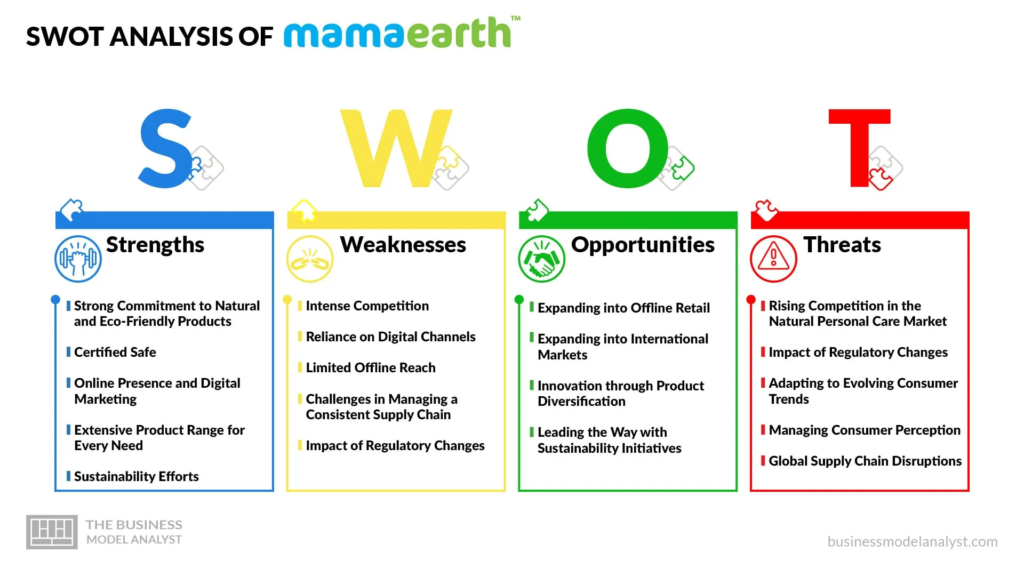
Strengths
- Strong brand recognition
- Effective Mamaearth business model
- Diversified Mamaearth revenue model
- Innovative Mamaearth marketing strategy
- Digital-first operations
- Consumer trust
Weaknesses
- Intense competition
- Dependence on digital channels
- High marketing expenses
Opportunities
- International expansion
- Premium product segments
- Sustainability initiatives
- Retail expansion
Threats
- New market entrants
- Consumer preference changes
- Regulatory challenges
- Pricing pressure
Key Success Factors
This Mamaearth case study identifies several important success factors.
Consumer-Centric Innovation
Product development aligns closely with customer needs.
Digital Excellence
Technology strengthens the Mamaearth business model and customer experience.
Revenue Diversification
The Mamaearth revenue model benefits from multiple sales channels.
Marketing Innovation
The Mamaearth marketing strategy effectively builds awareness and trust.
Sustainability Positioning
Purpose-driven branding enhances customer loyalty.
Lessons Businesses Can Learn
This Mamaearth case study provides valuable lessons for startups and entrepreneurs.
Solve Real Problems
Successful brands address genuine customer pain points.
Build Direct Relationships
The Mamaearth business model demonstrates the power of direct customer engagement.
Diversify Revenue Streams
The Mamaearth revenue model highlights the importance of multiple income sources.
Invest in Marketing
The success of the Mamaearth marketing strategy shows how digital marketing can accelerate growth.
Leverage Technology
Technology improves efficiency, scalability, and customer satisfaction.
Future Outlook
The future appears promising for Mamaearth.
The company is expected to continue investing in:
- Product innovation
- International markets
- Retail expansion
- Digital transformation
- Sustainability initiatives
The ongoing evolution of the Mamaearth business model, expansion of the Mamaearth revenue model, and refinement of the Mamaearth marketing strategy position the company for long-term growth.
Conclusion
This Mamaearth case study demonstrates how a startup can transform into a leading consumer brand through innovation, customer focus, and strategic execution. The Mamaearth business model combines digital-first operations, omnichannel distribution, and sustainability initiatives to create long-term value. The Mamaearth revenue model generates growth through diversified channels, while the Mamaearth marketing strategy effectively builds trust and customer engagement.
As consumer preferences continue evolving, Mamaearth remains well-positioned to capitalize on future opportunities. This Mamaearth case study serves as an excellent example of how understanding customers, leveraging technology, and maintaining strong brand values can drive sustainable business success.
FAQs
1. What makes the Mamaearth case study important for startups?
The Mamaearth case study is important because it demonstrates how a startup can challenge established brands through innovation, digital marketing, and customer-centric strategies. The lessons from the Mamaearth business model, Mamaearth revenue model, and Mamaearth marketing strategy are highly relevant for emerging businesses.
2. How does the Mamaearth business model create value?
The Mamaearth business model creates value through direct-to-consumer sales, product diversification, sustainability initiatives, omnichannel distribution, and technology-driven operations that improve customer experiences.
3. What are the primary income sources in the Mamaearth revenue model?
The Mamaearth revenue model generates revenue from product sales, website purchases, marketplace channels, retail stores, repeat customers, and new product launches across multiple categories.
4. Why is the Mamaearth marketing strategy considered successful?
The Mamaearth marketing strategy is successful because it combines influencer marketing, content creation, social media engagement, purpose-driven branding, customer reviews, and performance advertising to build trust and awareness.
5. What can entrepreneurs learn from the Mamaearth case study?
Entrepreneurs can learn how to create a scalable Mamaearth business model, develop diversified revenue streams similar to the Mamaearth revenue model, and implement customer-focused branding inspired by the Mamaearth marketing strategy.
6. How does sustainability strengthen the Mamaearth business model?
Sustainability strengthens the Mamaearth business model by improving customer trust, enhancing brand reputation, supporting innovation, and creating differentiation in a competitive marketplace.
7. How does digital commerce support the Mamaearth revenue model?
Digital commerce strengthens the Mamaearth revenue model by improving accessibility, increasing margins, providing customer insights, and enabling scalable growth through online channels.
8. What is the future of the Mamaearth marketing strategy?
The future of the Mamaearth marketing strategy will likely focus on artificial intelligence, personalization, omnichannel engagement, influencer collaborations, sustainability communication, and advanced customer analytics to improve acquisition and retention.







I got what you intend, thanks for putting up.Woh I am happy to find this website through google. “Spare no expense to make everything as economical as possible.” by Samuel Goldwyn.